

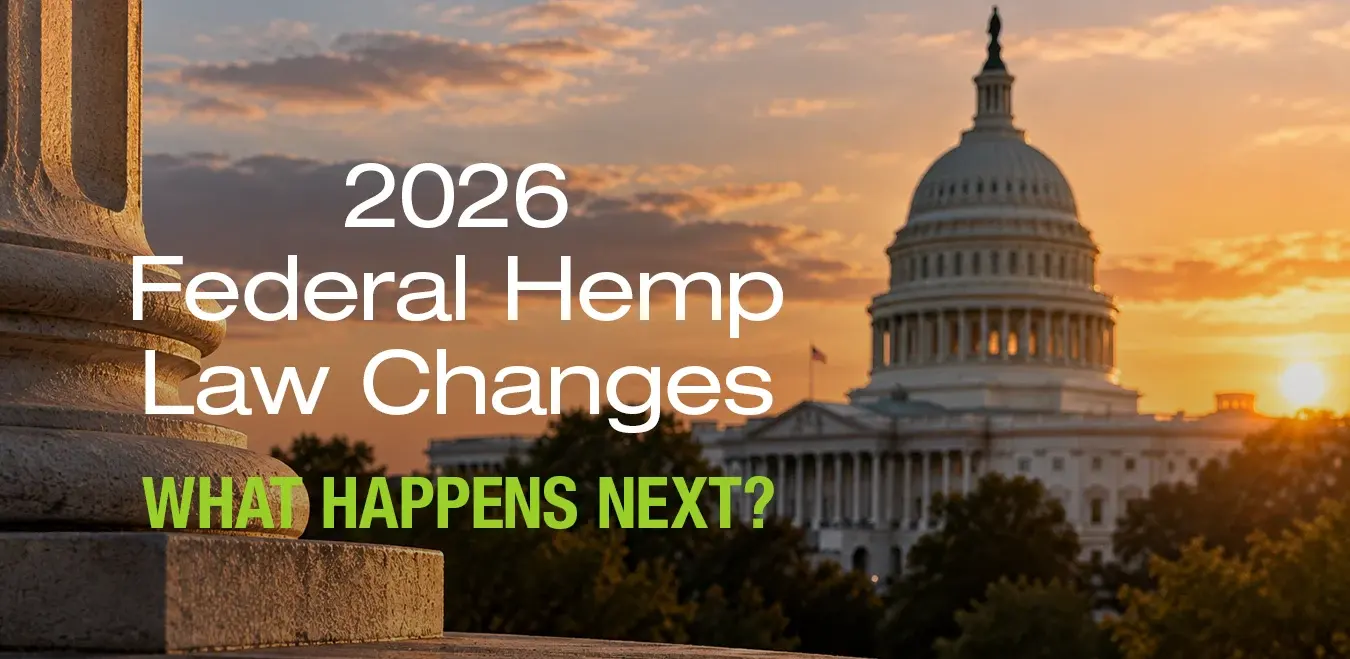
In November 2025, legislation was passed that put a one-year countdown on the clock for the “legal” hemp industry. “Legal” is in quotes because the intoxicating hemp product market was technically born from a loophole: hemp was defined by its THC potency on a “dry-weight” basis, measuring only delta-9 THC. That left the door open for products high in delta-8, THCA, and other cannabinoids to be sold as federally compliant hemp, so long as delta-9 stayed under 0.3%. After several years of explosive growth built on that loophole, it’s now set to close.
Congress has since pushed the deadline back a month, from November 12 to December 11, 2026. The new date aligns with the federal government’s continuing resolution spending deadline and pushes the policy fight past the midterm elections. The extension also reflects pressure from hemp businesses and their allies in Congress to build a regulatory framework instead of an outright ban. One important caveat: the extension doesn’t apply to synthetic or “converted” cannabinoids like delta-8, delta-10, and HHC. Those lose their hemp status on the original November 12 date, regardless of the reprieve given to everything else.
How the 2026 Federal Hemp Ban Could Impact the Industry
The shift from a delta-9-only standard to a “total THC” standard, combined with a 0.4 milligram-per-container cap on finished products, is expected to knock the vast majority of today’s intoxicating hemp products (THCA flower, hemp beverages, delta-8 gummies) out of federal compliance. Industry estimates put the share of currently sold products that would become unlawful under the new definition at roughly 95%. That’s an existential threat to the thousands of retailers, beverage makers, and hemp farmers who built businesses on the post-2018 loophole.
What the Hemp Market Could Look Like After December 11, 2026
Assuming no further delay or last-minute rewrite, expect a sharp split rather than a clean shutdown. Products sold in states with existing recreational or medical marijuana programs may migrate into those regulated markets, where dispensaries can legally sell THC at levels the new hemp definition forbids. That will effectively push hemp-derived THC customers toward marijuana retailers in states where that option exists. In the roughly two dozen states without legal recreational marijuana, though, the same products simply disappear from gas stations, smoke shops, and online retailers overnight, cutting off access for millions of consumers who relied on hemp as the only legal intoxicating option where they live.
Smaller hemp brands and single-state operators are the most exposed, since many lack the capital or formulation flexibility to reformulate under the 0.4 mg cap or pivot into compliant CBD and wellness products. Larger, well-capitalized players, particularly in the beverage space, are more likely to survive by reformulating toward ultra-low-dose or THC-free products, or by lobbying for state-level licensing regimes modeled on Tennessee’s, which already regulates hemp THC through its alcohol control board. Payment processors and banks are also moving ahead of the federal deadline: some have already told hemp merchants to wind down THC product sales by mid-October, which may compress the runway further for companies still hoping for a last-minute legislative fix.
The most likely long-term outcome is a more fragmented, state-by-state hemp market that looks a lot like early-stage cannabis legalization did a decade ago: legal in some places, banned in others, and heavily dependent on whether Congress eventually passes standalone hemp regulation like the Lawful Hemp Protection Act to reunify the rules.
Three outcomes remain plausible between now and December 11. Congress could push the deadline again, as it already has once, if industry lobbying and state pushback continue to build. Lawmakers could also strike a last-minute compromise, most likely by attaching a scaled-back version of the Lawful Hemp Protection Act or similar legislation to a must-pass bill, which would preserve a regulated (if smaller) hemp-THC market rather than eliminating it outright. Or the December date could simply hold, in which case expect swift legal challenges from hemp advocacy groups and a scramble among businesses to either relocate into legal marijuana states or exit the THC product category entirely. Given how consistently Congress has treated this as a moving target so far, a further delay or partial carve-out is arguably the safer bet than a clean, on-schedule ban.
Looking for regulated cannabis?
Explore Nova Farms dispensaries and shop licensed cannabis products in MA, NJ, ME, CT, and RI.